Browsed by
Tag: ipv6

miniSIPPhone V26.1

miniSIPPhone V26.1

The latest version of miniSIPPhone V26.1 has been released recently, which primarily includes the following key features or modifications:

1. support DTLS-SRTP

After miniSIPServer added support for DTLS-SRTP, we updated miniSIPPhone to enable encrypted voice stream transmission via DTLS-SRTP. When deploying enterprise communication networks, especially those involving external public cloud systems, we fully implement high-strength encryption for both signaling and media to ensure the security of enterprise communications.

In both miniSIPServer and miniSIPPhone, we have uniformly implemented the following restrictions for DTLS-SRTP:

(1) DTLS must be DTLSv1.2 or above.

(2) The encryption suite is fixed to SRTP_AES128_CM_SHA1_80. Although the specification defines several encryption suites, we use the highest-strength encryption and do not support negotiating other encryption suites.

(3) The fingerprint always uses SHA-256 encoding and does not support SHA-1 or other encoding methods.

2. Simplify SIP account configuration

In the new version, when configuring SIP accounts, there is no longer a need for separate configuration to specify the port, as shown in the figure below:
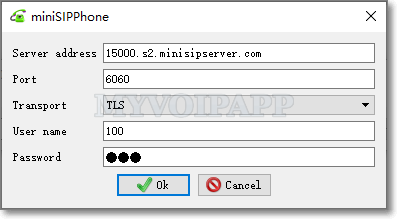
Typically, SIP servers use standard ports to provide services, and users do not need to understand the port information specified by the protocol (just as we rarely specify or know about ports like 80 and 443 when accessing the internet). Therefore, we have removed the “Server Port” configuration option.

However, there are cases where SIP servers use non-standard ports (for example, miniSIPServer Cloud uses port 6060 for SIP-TLS access instead of the standard 5061 port). In the new version, we can specify both the address and port information together in the “Server Address” field, for example:

15000.s2.minisipserver.com:6060

If the server provides an IPv6 address and a non-standard port, we can configure it using the following example method:

[fe80::5a11:22ff:fe74:8198]:6060
Trace on IP address

Trace on IP address

Previous miniSIPServer has a trace tool which is “trace all”. It can capture and trace all SIP calls which MSS receives or sends out. This tool is very useful when we build the VoIP network at the first step. But it is almost useless in an exist working environment.

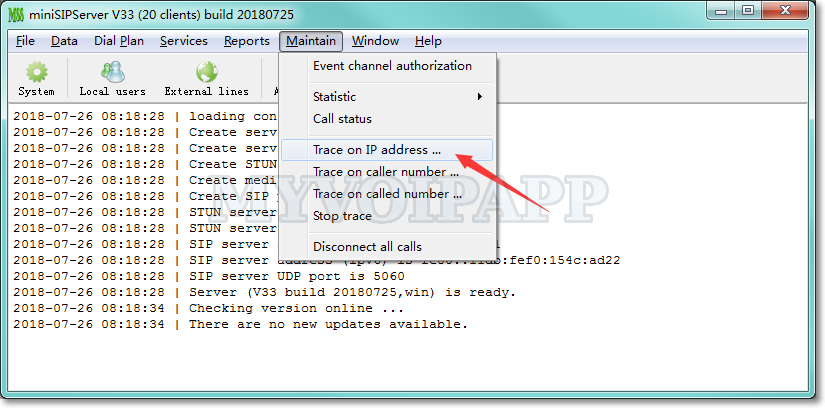
It is dangerous to capture ALL SIP calls in a working system since there are too many SIP messages and inner information. By default, we can filter the call according to caller number or called number. In the recent V33 version, we disable “trace all” and replace it with “trace on IP address”. Please refer to following figure.

Trace on IP address
Trace on IP address

With this tool, we can capture a specific complete IP address, such as “10.0.0.101”. We can also set a part of IP address to capture some SIP calls from some IP addresses, such as “10.0.0”, in this scenario, all SIP calls from IP addresses begin with “10.0.0” will be captured. By the way, we can also set IPv6 address with this tool.

Now you can see this tool can be used in both lab environment and working environment.

new LTS V16 and new stable V17

new LTS V16 and new stable V17

V16 has been released for several days and response messages from our customers are very exciting, so we decide to upgrade LTS version to V16 since it can support very important feature: IPv6.

At the same time, the latest stable version is upgraded to V17. In this version, something is changed:

Event channel is provided

“Event channel” is based on websocket, and customers’ applications can establish websocket connection to get MSS inner call status. Please refer to online document:

http://www.myvoipapp.com/docs/mss_services/event_channel/index.html

MSS trunk

“MSS trunk” is our private protocol to bypass some ISP blocking. It helps some customers to deploy VoIP network at their sides. At this time, since MSS can support SIP over TLS, we think this feature could be replaced by it, so we decide to remove this feature from V17 and abover versions.

We hope new versions can fit your requirements and benefit your VOIP network. Please enjoy them and update us if you have any suggestion or question.

Big thing – IPv6!

Big thing – IPv6!

As we know, IPv6 is next internet protocol. All SIP devices will be migrated to IPv6 since IPv4 network has more and more problems.

Today we release miniSIPServer V16. The big feature of this version is to support IPv6. You can find it is so eay to deploy a voip network over IPv6 with miniSIPServer.

Please refer to following document for more details and enjoy IPv6 now!

http://www.myvoipapp.com/docs/mss_services/ipv6/index.html

And V16 will be next LTS version once we think it is ready for that.