Browsed by
Category: miniSipPhone

SIP softphone.

miniSIPPhone V26.1

miniSIPPhone V26.1

The latest version of miniSIPPhone V26.1 has been released recently, which primarily includes the following key features or modifications:

1. support DTLS-SRTP

After miniSIPServer added support for DTLS-SRTP, we updated miniSIPPhone to enable encrypted voice stream transmission via DTLS-SRTP. When deploying enterprise communication networks, especially those involving external public cloud systems, we fully implement high-strength encryption for both signaling and media to ensure the security of enterprise communications.

In both miniSIPServer and miniSIPPhone, we have uniformly implemented the following restrictions for DTLS-SRTP:

(1) DTLS must be DTLSv1.2 or above.

(2) The encryption suite is fixed to SRTP_AES128_CM_SHA1_80. Although the specification defines several encryption suites, we use the highest-strength encryption and do not support negotiating other encryption suites.

(3) The fingerprint always uses SHA-256 encoding and does not support SHA-1 or other encoding methods.

2. Simplify SIP account configuration

In the new version, when configuring SIP accounts, there is no longer a need for separate configuration to specify the port, as shown in the figure below:
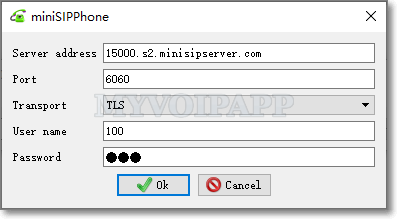
Typically, SIP servers use standard ports to provide services, and users do not need to understand the port information specified by the protocol (just as we rarely specify or know about ports like 80 and 443 when accessing the internet). Therefore, we have removed the “Server Port” configuration option.

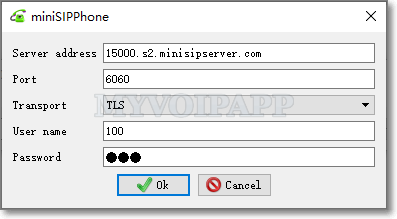
However, there are cases where SIP servers use non-standard ports (for example, miniSIPServer Cloud uses port 6060 for SIP-TLS access instead of the standard 5061 port). In the new version, we can specify both the address and port information together in the “Server Address” field, for example:

15000.s2.minisipserver.com:6060

If the server provides an IPv6 address and a non-standard port, we can configure it using the following example method:

[fe80::5a11:22ff:fe74:8198]:6060
miniSIPPhone supports SIP over TCP/TLS

miniSIPPhone supports SIP over TCP/TLS

Yes, we upgrade miniSIPPhone. Again!

miniSIPPhone V10.10 can support SIP over TCP and TLS now. In the account configuration, there is a new item ‘Transport’ to indicate which transport should be used to connect to SIP server.

miniSIPPhone account configuration, including transport configuration.

If SIP is over TLS, the messages are encrypted. It is quite necessary for enterprise communication if the servers or clients are deployed in public networks. As we know cloud miniSIPServer can support SIP over TLS and all virtual servers are deployed in the public network, so if you deploy miniSIPPhone at the same time, it could be safer for the whole VoIP network.

Of course, miniSIPPhone can work with other SIP servers who can support SIP over TCP/TLS to build a complete and safe enterprise VoIP system.

Send or receive instant messages

Send or receive instant messages

The latest version of miniSIPPhone is released today to support two key features: (1) Contact, and (2) Instant messages.

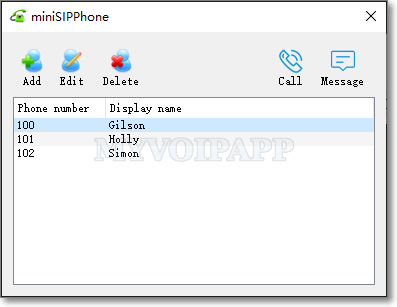
It has a new window to create and manage contact list like belowing:

miniSIPServer contact list

In the contact window, you can select the target user and double click it to make a call out, or you can press ‘C’ key or click ‘Call’ button to do that.

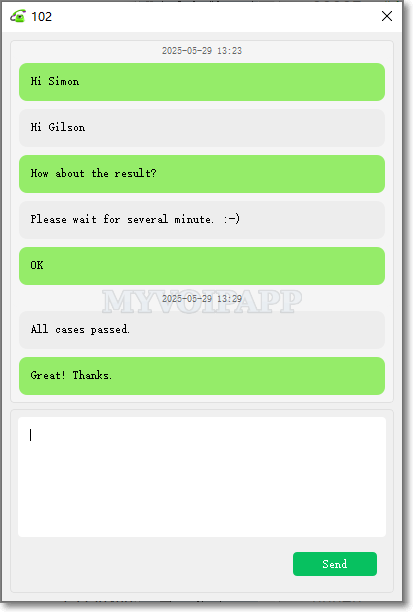
If you want to send instant messages, you can select the target user and press ‘M’ key or click the ‘Message’ button, then you will get instant messages’ windows:

Instant message window on Windows system
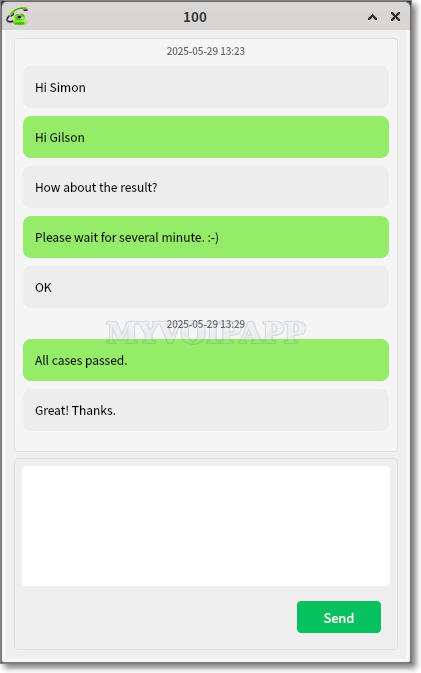
Instant message window on Linux system

One instant message window is used for one user. Each window has three areas: (1) Display area. It displays both incoming messages and outgoing messages. (2) Input area. You can input the instant message content here, and press ‘Ctrl+Enter’ keys to send the message out. (3) ‘Send’ button. Click it to send the message out.

At this time, miniSIPPhone uses SIP-MESSAGE to send and receive instant messages, and can only support plain text messages, so you cannot insert images, files, audios and videos into the messages.

Of course, miniSIPPhone can run on Windows system and Linux system (including AMD64 and ARM64). In fact, the users in above figure run miniSIPPhone on different systems.

Hope you can enjoy it. 🙂

miniSIPPhone for Linux (Debian/Ubuntu)

miniSIPPhone for Linux (Debian/Ubuntu)

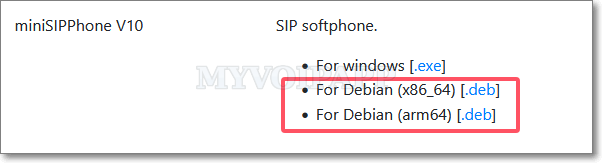
Finally, miniSIPPhone is upgraded to V10. The most important thing is that it can support Linux system now. Of course, the distro must be Debian or Ubuntu. As same as miniSIPServer, Debian must be V10 (Buster) or higher versions, and Ubuntu must be V18.04 (Bionic Beaver) or higher versions.

Both X86_64 (amd64) and ARM64 (AArch64) are supported.

It is quite easy to run SIP phone on Linux system now. Please visit our website to download the latest version:

For example, you download “msp_v10_amd64.deb” and install it with following command:

sudo dpkg --install msp_v10_amd64.deb

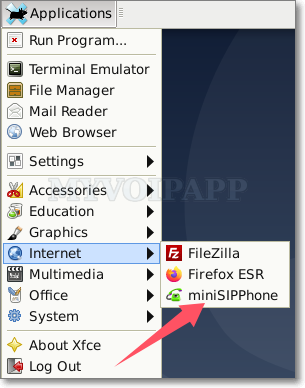
Then you can click the linker to run miniSIPPhone:

If you want to uninstall miniSIPPhone, you can run following command directly to remove it:

sudo apt remove minisipphone
miniSipPhone is coming!

miniSipPhone is coming!

At the begining of this year, we upgrade our miniSipPhone to V2 and release it today!

We add some features into MSP V2. For example, some customers are always confused with one-way audio problem. In MSP V2, we configure default STUN process and it can detect NAT automatically. Customers don’t need to configure STUN again.

The new version is as simple as enough, we believe you will find it is so easy to use and hope you can enjoy it!

If you are interesting in it, please visit our website and download it to take a try:

http://www.myvoipapp.com/download/